
Specifications, Installation Sequence & Structural Role
1. Supply and Technical Specifications:
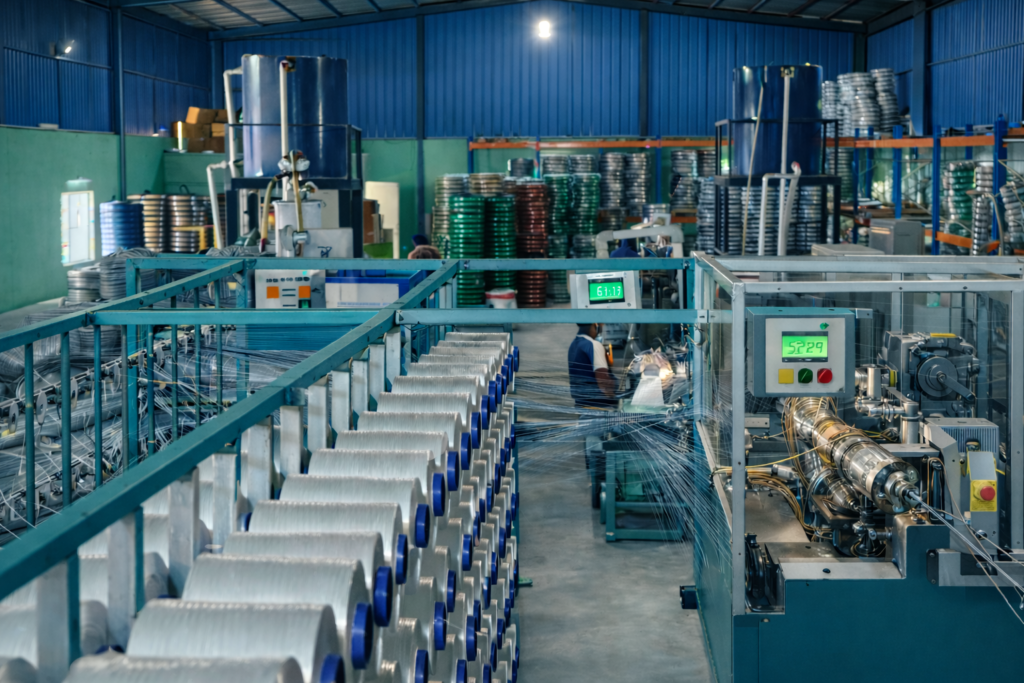
Geostraps are high-performance composite strips made of high-tenacity polyester (PET) yarns encased in a protective polyethylene (PE) or LLDPE sheath.
Tensile Strength: Typically available in grades from 30kN to 100kN, though heavy-duty options can reach up to 190kN.
Standard Dimensions: Most strips are 85mm to 95mm wide and supplied in rolls of roughly 100 to 136 meters.
Durability: Engineered to resist UV radiation, biological degradation, and chemical soil environments (pH 5–9) for a design life of up to 120 years.
Environmental Product Declaration for Geostrap reinforcement
2. Installation Sequence:
The installation is a systematic, bottom-up process integrated with soil backfilling.
Foundation & Leveling: A concrete leveling pad is cast to provide a perfectly level base for the first row of facing panels.
Panel Erection: Facing panels are placed and braced. Temporary wedges are often used to maintain a slight inward batter to compensate for outward soil pressure during compaction.
Backfill Compaction: Soil is placed in 200mm lifts and compacted to specific densities (often 95% Modified Proctor) until it reaches the level of the first row of strap connectors.
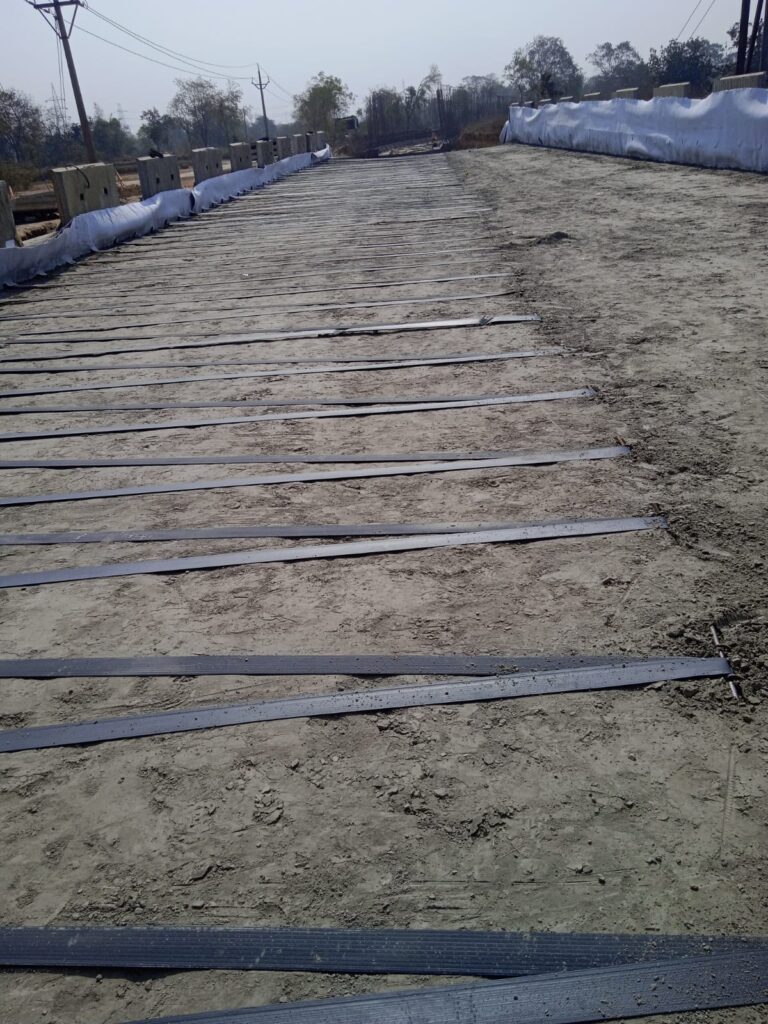
Strap Attachment: Geostraps are pulled through connectors (like cavity loops or galvanized bars) on the back of the facing panels.
Tensioning: Straps are laid flat and pulled taut across the compacted soil to ensure they activate immediately under load.
Repetition: The process is repeated—layer by layer—until the design height is achieved, finished with a final coping beam.
1. What is the role of Geostraps in MSE wall construction?
Geostraps provide tensile reinforcement to the soil mass, helping the wall resist lateral pressure and improving overall structural stability.
2. What tensile strengths are commonly used for Geostraps?
They are usually available from around 30kN to 100kN, with heavy-duty options going up to about 190kN depending on design load requirements.
3. How are Geostraps installed during construction?
They are attached to facing panel connectors, laid flat over compacted soil layers, tensioned properly, and then covered with the next backfill lift as construction progresses upward.
4. How durable are polymeric Geostraps in soil environments?
High-quality PET geostrips with PE or LLDPE coating are designed to resist UV exposure, chemicals, and biological degradation, often achieving design lives of up to 100–120 years.
More Services
Contact With us
Flat no 102, Srinilayam, Mathrusree Nagar
Hafeezpet, Miyapur, Hyderabad, Telangana 500049
soilsolprojects@gmail.com
techgeoindustries@gmail.com