
Key Concepts, Components & Advantages
A Reinforced Soil Wall (RSW), often called a Mechanically Stabilized Earth (MSE) wall, is a composite structure that combines soil with tensile reinforcement materials to create a stable, often vertical, retaining structure.
How it Works:
The wall gains its strength from the friction and mechanical interlock between the backfill soil and the reinforcing elements. While soil is strong in compression, it is weak in tension; the reinforcement (strips or grids) provides the necessary tensile strength, allowing the soil mass to act as a single, coherent gravity unit
Core Components:
Reinforcing Elements: High-tensile materials such as geogrids (polymeric mesh), steel strips, or geotextiles are laid horizontally in layers.
Backfill Soil: Typically granular, free-draining material (like gravel or sand) that compacts well and provides high friction.
Facing Elements: The visible part of the wall. Common types include:
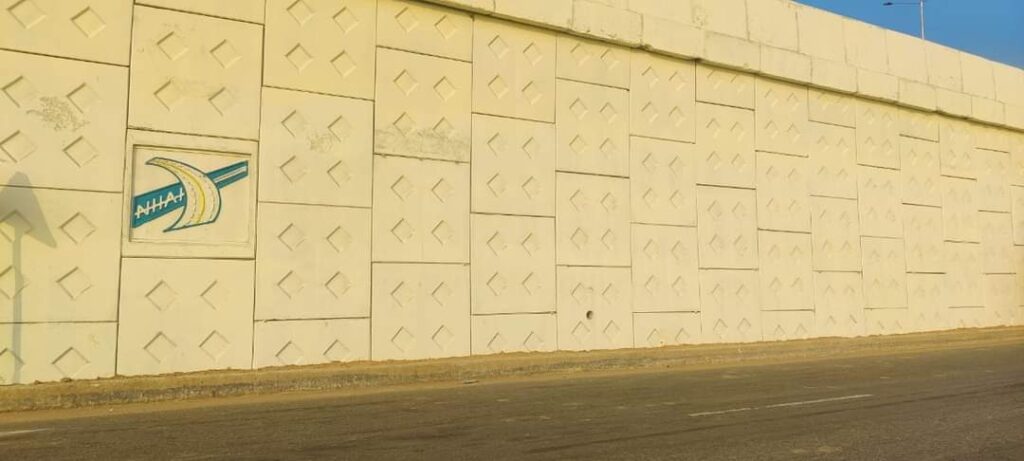
Precast Concrete Panels: Interlocking panels used for high-load highway embankments.
Modular Blocks: Smaller concrete blocks popular in landscaping.
Gabions: Wire mesh baskets filled with stone.
Wrapped Face: Geotextiles wrapped around the soil face for a softer, more flexible look.
Key Advantages:
Cost-Effective: Significantly cheaper than traditional RCC (reinforced cement concrete) retaining walls.
Flexible: Can tolerate large settlements and differential movement, making them ideal for poor soil or seismic zones.
Rapid Construction: They do not require complex scaffolding or long curing periods, as they are built from the bottom up in repetitive layers.
1. What is a Reinforced Soil Wall used for?
Reinforced Soil Walls are mainly used for retaining soil in highways, flyovers, rail embankments, bridge approaches, and landscaping projects. They help support vertical or near-vertical slopes while maintaining stability.
2. What type of soil is suitable for RSW construction?
Granular, free-draining soils like sand or gravel are preferred because they compact well and create strong friction with geogrids or reinforcement layers. Clayey or highly plastic soils are usually avoided.
3. How is an RSW different from a traditional RCC retaining wall?
An RSW works as a reinforced soil mass rather than a rigid concrete structure. It is more flexible, faster to build, and generally more cost-effective, especially in areas with settlement or seismic movement.
4. What facing options are available in Reinforced Soil Walls?
Common facing types include precast concrete panels, modular concrete blocks, gabions, and wrapped geotextile faces. The choice depends on load requirements, design aesthetics, and project budget.
More Services
Contact With us
Flat no 102, Srinilayam, Mathrusree Nagar
Hafeezpet, Miyapur, Hyderabad, Telangana 500049
soilsolprojects@gmail.com
techgeoindustries@gmail.com